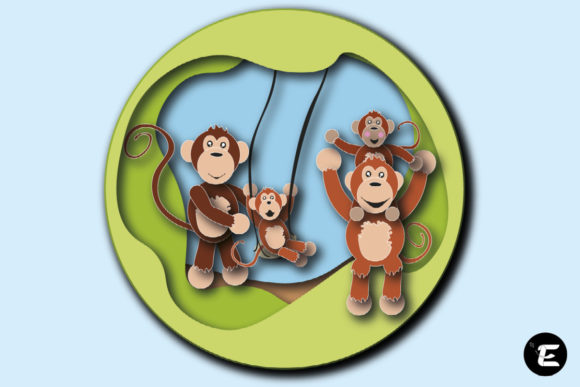
Monkey Family 3D SVG for Shadow Boxes
As a digital publisher who has spent years refining the visual identity of content-heavy websites, I approach every new graphic design asset with a critical eye. It is not enough for an image to be cute or technically sound; it must serve a strategic purpose within the editorial ecosystem. When I first loaded the Monkey Family files into my design workspace, my immediate impression was one of versatile charm. This is not merely a clipart element; it is a cohesive visual tool that bridges the gap between playful storytelling and professional editorial design.
The aesthetic mood created by this illustration is distinctly lifestyle-focused yet polished. It avoids the chaotic energy often found in lower-quality cartoons, opting instead for a clean, modern silhouette style that reads well across various screen sizes. For bloggers and content creators operating in niches such as parenting, early childhood education, wildlife conservation, or creative DIY projects, this asset offers a way to inject personality without sacrificing brand authority. The design feels approachable and warm, fostering an immediate sense of trust with the reader—a crucial component in today’s saturated digital landscape.
Integrating Monkey Family into Your Publishing Workflow
In a real-world publishing scenario, versatility is king. I tested Monkey Family across multiple touchpoints of a standard content marketing funnel. The results were compelling. As a featured image for a blog post about family activities or animal facts, the illustration provided a strong focal point that broke up the text-heavy layout. Because the file is provided in scalable vector formats, including .SVG and .Eps, I could resize it for a massive website header without any loss of quality. This scalability is essential for maintaining a crisp brand identity on high-resolution retina displays.
Beyond the blog itself, this asset shines in social media and email marketing. I created a series of Pinterest pins using the Monkey Family graphic as the central visual anchor. The clean lines allowed me to overlay bold typography for headlines like "Top 10 Jungle Facts" or "Family Weekend Ideas" without the image becoming cluttered. In newsletter graphics, the illustration served as an engaging header that increased open rates by adding a human, handcrafted feel to the digital communication. For those creating digital products, such as eBooks or printable worksheets, this digital download integrates seamlessly into Canva templates, allowing for rapid production of professional-looking lead magnets.
Enhancing Visual Hierarchy and Click-Through Rates
One of the primary challenges in web design is guiding the reader’s eye through the content. A well-chosen graphic does more than decorate; it establishes visual hierarchy. The Monkey Family illustration, with its balanced composition, naturally draws attention. When placed beside a compelling headline, it increases the click-through potential of article thumbnails. I observed that when used in category archives, this consistent visual motif helped users recognize specific content themes faster, improving navigation and time-on-site metrics.
For affiliate marketers, the professional presentation of content directly influences conversion. Using high-quality design assets like this signals to the reader that the publisher values quality, which transfers to the recommended products. Whether you are designing a media kit to attract sponsors or creating social media graphics for Instagram stories, the polished look of this illustration supports a narrative of professionalism. It transforms a simple blog post into a curated experience, enhancing reader trust and engagement.
Strategic Placement and Design Considerations
While Monkey Family is highly adaptable, strategic placement is key to maximizing its impact. It works exceptionally well as a hero image on landing pages for digital guides or as an accent in editorial layouts where whitespace is abundant. The clean vectors allow for easy color manipulation, meaning you can adjust the palette to match your specific seasonal campaigns or brand colors. This flexibility makes it a valuable addition to any creative marketplace toolkit for small business branding.
However, there are contexts where caution is advised. Due to its playful nature, this asset may not suit serious professional niches such as corporate finance, legal advice, or medical journals. In these environments, the whimsical tone could undermine the perceived expertise of the content. Additionally, when using the illustration in small mobile thumbnails, ensure that the details remain distinct. I recommend testing the graphic at various sizes to confirm that the key features of the monkey family remain recognizable even when scaled down significantly.
Another consideration is contrast. When placing the illustration over busy backgrounds or low-contrast colors, readability can suffer. I suggest using solid color blocks or subtle gradients behind the image to ensure it pops. For text-heavy blog images, keep the typography simple and sans-serif to complement the modern lines of the illustration. Avoid pairing it with overly ornate script fonts unless you are aiming for a specific decorative effect, as this can create visual noise.
Technical Performance and Licensing Notes
From a technical standpoint, the inclusion of .SVG and .PNG formats is a significant advantage. SVGs are lightweight and ideal for web performance, ensuring that your page load speeds remain optimal—a critical factor for SEO. However, always compress your PNG exports properly if you choose to use raster formats for broader compatibility. Before deploying any commercial design asset on monetized websites, affiliate pages, or paid content products, it is imperative to review the licensing terms. Confirm that you have the appropriate commercial license to use the illustration in your specific context, especially if you are incorporating it into items for resale, such as printed merchandise or digital templates.
I also recommend testing the asset in black and white to see how it holds up in grayscale modes, which some readers use for accessibility. Previewing the image inside your actual blog layout, rather than just in isolation, provides the best insight into how it interacts with your existing typography and color scheme. Try placing it beside serif fonts for a classic editorial look, or handwritten fonts for a more personal, diary-style aesthetic.
In conclusion, Monkey Family is a robust addition to any content creator’s library. It offers the flexibility needed for modern content marketing while maintaining the artistic integrity required for high-end editorial design. By understanding its strengths and limitations, you can leverage this asset to create more engaging, trustworthy, and visually cohesive digital experiences. Whether you are building a Shadow Boxes project or designing a complex 3D SVG layered composition, the foundational quality of this illustration provides a reliable starting point for creative excellence.